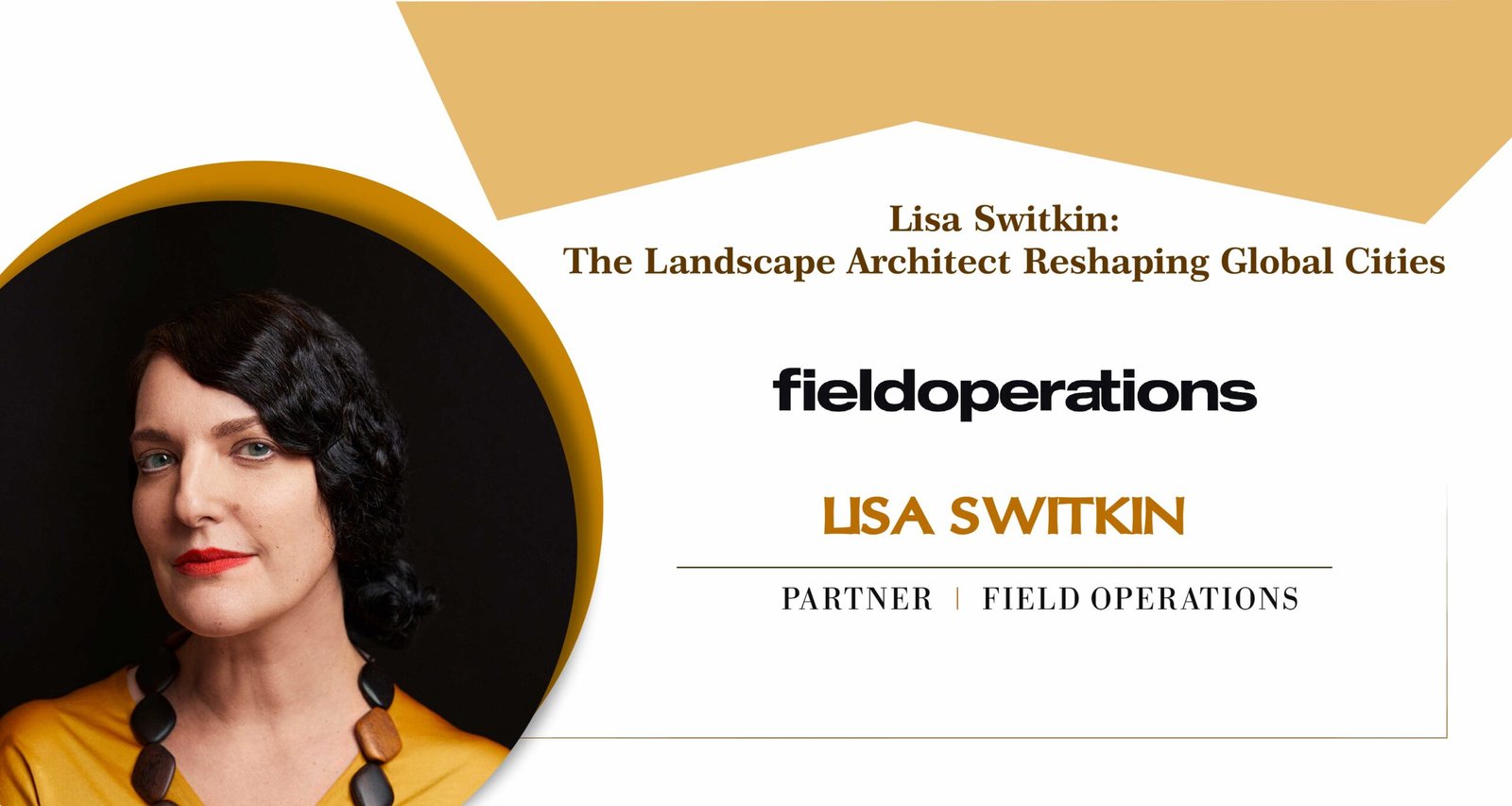
In landscape architecture and urban design, few leaders bring the same level of vision, innovation, and community focus as Lisa Tziona Switkin. As a Partner at Field Operations, she has led complex public realm projects that address community needs, redefining how public space engages with the city. From the iconic High Line to transformative waterfronts like Domino Park and Hudson River Park’s Gansevoort Peninsula, her projects are a testament to place, history, and public life.
Lisa Switkin’s Founding Inspiration for Public Space
Lisa Switkin traces her inspiration for landscape architecture to a story her father often told. Born in 1937, he grew up in a 1-bedroom apartment in Chicago, shared with his parents, his sister, and his grandmother. His takeaway was not about hardship, though that was implied. In his words, “I never knew I was poor, because Lake Michigan was my backyard.”
Lisa didn’t realize the impact that story would have on her life and career, but she returns to it often. The notion of public space as essential—contributing to people’s dignity, sense of belonging, health, and well-being—continues to inspire and shape her work.
From a young age, Lisa was drawn to cities and the public spaces within them. She realized early that public space is one of the most valuable things a city can offer: it shapes identity and character, creates places everyone moves through and experiences, and allows anyone to show up, slow down, and belong. She was excited by the idea that design could amplify all of that—that the built landscape is the primary stage of civic life and carries the most impact.
Lisa’s 25-Year Evolution at Field Operations
Lisa’s journey with Field Operations began in 1999, when she started her Master’s in Landscape Architecture at Penn and joined James Corner as his Teaching and Research Assistant.
From its beginning, the firm launched with a radical idea: that landscape could be transformative at an urban scale and that it could lead. The High Line was not yet built. Freshkills was just beginning.
Over 25 years, Lisa’s role has evolved with the firm’s growth from a start-up to global practice. Early on, she led all aspects of a project: design, stakeholder engagement, team coordination, and development of technical details. Currently, she oversees multiple projects, serving as a design partner, strategic resource, or lead on public engagement and client relationships. She also plays a critical role in business development and studio operations as Field Operations has grown from a sole-owner practice to a partnership.
The design culture remains constant. Lisa points to the firm’s belief that design matters, that innovation happens at every scale, and that the work reveals a place’s essence rather than imposing on it. She is proud of what the firm has built, and that women make up half the studio and two-thirds of senior leadership—an outcome she notes did not happen by accident.
The Public Realm as Framework: Designing Urban Transformation
For Lisa, transformative urban design understands the public realm as an organizing framework, not as leftover in-between spaces. She sees it as what gives a city character, identity, and vitality. Her process begins with listening to the site’s ecology, community, and culture. Starting from this point, her work is driven by context, not signature style, creating lasting impact.
Lisa’s most transformative projects are inspired by place, unfold as layered experiences, and are anchored in community. At Seattle’s Central Waterfront, removing the Alaskan Way Viaduct reclaimed 1.5 miles of industrial edge as a 20-acre park integrating a new seawall, habitat, gardens, and art. The Overlook Walk turns a 100-foot grade change into a durational journey from Pike Place Market to the bay.
For Lisa, the measure of transformation is spatial and experiential. Design can reshape how people experience cities. Wonder, recognition, belonging, and curiosity — these are not afterthoughts. They are the point.
Designing Complex Urban Landscapes
Lisa does not see creativity and functionality as opposites. According to her, the most creative solutions are the most functional because they emerge from a deep understanding of how a place works: how people move through it, how water flows, what light does throughout the day, and which ecological systems are present.
At Freshkills Park, the transformation of the landfill on Staten Island into a park, the creative idea involves accelerating natural processes to renew and diversify the ecology of the site. By letting the landscape regenerate, Freshkills is now home to the region’s largest grassland habitat and a living lab for urban ecology. The pragmatic response to a site of that scale was also the most inventive.
For Guiwan Park, a massive shoreline transformation in the Pearl River Delta, a concrete channelized river with extremely poor water quality transforms into a new ecological sponge-city park. Water fingers organize development and infrastructure, functioning as both amenity and green machine. Once treated, water becomes the park’s identity, resource, and attraction.
Public Space as Civic Infrastructure
Public space is where cities express their identity. It is a part of urban life that belongs to everyone, which matters as cities face privatization, inequality, and density. Lisa sees the public realm as a place to create and express shared vision and values, to tell and reveal stories, and to foster connection to place.
Designing for community means designing for everyone who might show up, not just those who are expected. At Domino Park, Field Operations honors the Domino Sugar Refinery’s legacy while creating access to the East River for the first time in 160 years. Driven by community engagement, the 5-acre park balances active and passive uses and has become one of Brooklyn’s most diverse parks.
The Underline shows how infrastructure can become civic space. The 10-mile linear park beneath Miami’s Metrorail was shaped by community needs, ambitions and insight. It pairs habitat with multimodal paths and free cultural, fitness, and educational programming to improve well-being and access to nature.
Lisa grounds her work in the idea that holistic, integrated design can deliver multiple social, ecological, and economic benefits. Research links access to public space and nature to improved physical and mental well-being, stress reduction, and enhanced social cohesion. For her, that is why landscape architecture and this work matter so urgently now.
Crafting Timeless Urban Landscapes
For Lisa, timelessness comes from grounding design in the specific ecology, history, memory, and culture of a place. She points to the High Line, which endures not because it is fashionable, but because it is rooted in Manhattan’s West Side. Its pathways and social spaces create a dialogue with the city, its planting recalls the self-sown landscape that once grew there, and its materials reflect the infrastructure beneath. That specificity keeps it relevant and timeless.
At the same time, the best public spaces encourage interaction and balanced uses. They hold structure and openness at once. Hudson River Park’s Gansevoort Peninsula transforms a former sanitation site into a 5.5-acre park that integrates resilient infrastructure with public amenities. It addresses climate adaptation, enhances biodiversity, and provides recreation for one of New York’s densest neighborhoods. A ballfield, boat launch, and fitness area pair with Manhattan’s first public beach and the Hudson River’s first salt marsh in Manhattan—creating a resilient shoreline that adapts to climate, community, and need.
Finally, it is important to design for multiple scales of experience, the vast and the intimate. A space that works at the scale of the city must also hold intimate details: a unique edge, a texture underfoot, a framed view. Those tactile, immediate experiences are what make places feel alive through decades of change.
Weaving Climate and Ecology in the City
Climate is not an add-on—it is the design. Almost every project Field Operations takes on weaves resilience and ecology into the design, where living systems, water management, and habitat become part of the experience. The firm’s work often transforms underutilized industrial sites into dense, layered environments that support people while restoring ecological health.
At Freshkills, restoration performs at the city scale. During Hurricane Sandy, the 2,200-acre park absorbed critical storm surge, proving that ecological recovery and flood resilience are linked. Now recognized for mitigation, it is also delivering habitat and access to nature for millions.
Guiwan Park in Shenzhen demonstrates that ecological infrastructure can be productive, beautiful and experiential. Field Operations transformed a degraded tidal channel into a living system and coastal park with water fingers that collect, retain, filter, and cleanse stormwater, interwoven with wetlands and mangroves. Aligned with China’s Sponge City policy, the park captures 70% of rainwater for reuse while serving as a green lung for a dense city.
Across projects, Field Operations deploys hybrid green-gray-blue solutions. The new Elliott Bay Seawall integrates a salmon migration corridor, tidal habitat, and pedestrian promenade. A constructed beach, textured seawall panels, and light-penetrating surface support aquatic life while inviting people to the water. For Lisa, resilience must be integrated and beautiful—something people value and want to be part of.
The Latest Trends in Public Space Design
The most significant and hopeful shift in public space design is recognizing it as essential infrastructure, not an amenity. The idea that green space can be separated from the systems that keep a city functioning is over. Today’s public spaces are designed for recreation and gathering and simultaneously for biodiversity, water management, habitat, air quality, and climate resilience.
She sees a move toward adaptive landscapes designed as living systems. Rather than fixed objects, the best public spaces change, grow, and surprise. That requires clients and communities to let the landscape lead and trust the process.
Lisa emphasizes centering communities most affected by urban change. Those facing development pressure, climate vulnerability, and a lack of green space need to be at the heart of the design process. That shift determines what gets built and for whom.
There is also a growing focus on holistic well-being. Lisa notes a meaningful values shift toward designing for mental health, belonging, and slower rhythms of life that cities often crowd out—moving from landscapes as resources to be optimized toward places that are nurtured and protected over time.
Finally, site specificity and locality matter more than ever. As global data proliferates, people hunger for the rooted and real. Place-based design draws on local ecology, materials, and culture, making spaces more sustainable, resilient, and meaningful. When a place is designed with people, Lisa says, they care for it differently.
Technology as a Listening Tool
For Lisa, technology is a listening tool, not a replacement for deep site knowledge. It gives designers extraordinary ways to understand cities—modeling climate scenarios, tracking movement and use patterns, visualizing design options, and overlaying engineering, infrastructure, and ecological systems at multiple scales. These tools genuinely improve what is grounded in place.
Technology also helps communicate complex ideas and foster innovation. The team uses it to imagine new futures, unpack complexity, and even strategize construction sequencing and phasing, making intricate systems legible to clients and communities.
She is especially interested in technology that captures qualitative experience. Beyond metrics, she asks how it can reveal who spaces serve, how different people feel in them, and what makes them unique, familiar, or surprising. For Lisa, the promise lies in using technology to motivate healthier lives and deeper care for the planet, pairing data with empathy to shape how cities are planned and experienced.
The Future Roadmap of Field Operations
Lisa envisions Field Operations continuing to lead at the intersection of design excellence, ecological intelli gence, and civic ambition. She values the firm’s ability to operate at the scale of entire urban districts while holding the detail, material quality, and specificity of individual experience and place.
Looking ahead, she aims to deepen the practice’s work in climate adaptation. For Lisa, this means not only incorporating resilience strategies but also designing landscapes that model what a climate-responsive city looks and feels like. She is interested in resilience work that pushes beyond regulatory frameworks to work at the scale of watersheds and bioregions, rather than individual development parcels.
She also wants to keep imagination and innovation at the center of the work, creating places that inspire wonder, deepen a sense of place, and foster connections to land and water. For Lisa, that experiential dimension is not separate from ecological and civic ambition. It is what makes people care.
Globally, she sees landscape architecture as an urgent necessity. With cities under pressure from all sides—cli mate, inequality, density, and rapid urbanization—Lisa believes the firm’s role is to demonstrate, project by project, that good design is not a luxury. It is how cities survive and thrive.
Vision for Urban Ecology: Integrating Ecology and Architecture
“I think we are moving toward a much more integrated understanding, where ecology is not the ‘natural’ counterpart to the ‘built’ city but part of the same system,” shared Lisa. While architecture, landscape, and infrastructure increasingly overlap, she believes each discipline should deepen its expertise, instead of doing it all.
She expects ecological design to become the baseline. Clients will routinely ask how projects support biodiver sity, manage water, and perform in a warmer, wetter, more volatile climate. These will be standard questions, not advanced ones.
Lisa also thinks the relationship between urban life and ecology will become more visceral and more visible. The pandemic deepened people’s need for nature in cities. The future city weaves ecological health and experience into daily life: not as an escape, but as its highest expression.
This integrated approach has shaped her work for 25 years, and she sees it as more urgent and more possible than ever.
Lisa Switkin’s Advice: Building Impact
For young architects looking to create meaningful, large-scale impact, Lisa advises them to begin with deep listening. The most essential and undervalued skill in this field is the ability to truly read a place—its ecology, its history, its community, and its contradictions. Before proposing solutions, she emphasizes understanding what already exists. The strongest designs, in her view, do not impose; they reveal and amplify what is latent within a site.
She urges emerging designers to stay curious and keep learning from the sites you work on, the communities you serve, and the collaborators alongside you. The best designers, Lisa observes, remain genuinely open to being surprised by a place, changed by a community’s vision, and willing to discover that the right answer may be different from their initial assumption. That openness consistently elevates the work.
Developing a clear point of view is crucial. Lisa stresses that lasting projects are rooted in a vision, not a style. What do you believe? The work that lasts is work that has something to say.
Building relationships is fundamental. This field runs on trust with clients, communities, and collaborators. Lisa’s most impactful work has come from long-term partner ships that enable risk-taking and ongoing stewardship.
She also pushes back on a false choice she sees in the field: that formal design ambition — the pursuit of beauty, innovation, and physical expression — is some how in tension with purpose and care. In her experience, the opposite is true. The most inventive work is also the most committed to the people and places it serves. Design ambition and public good are not opposites. They strengthen each other.