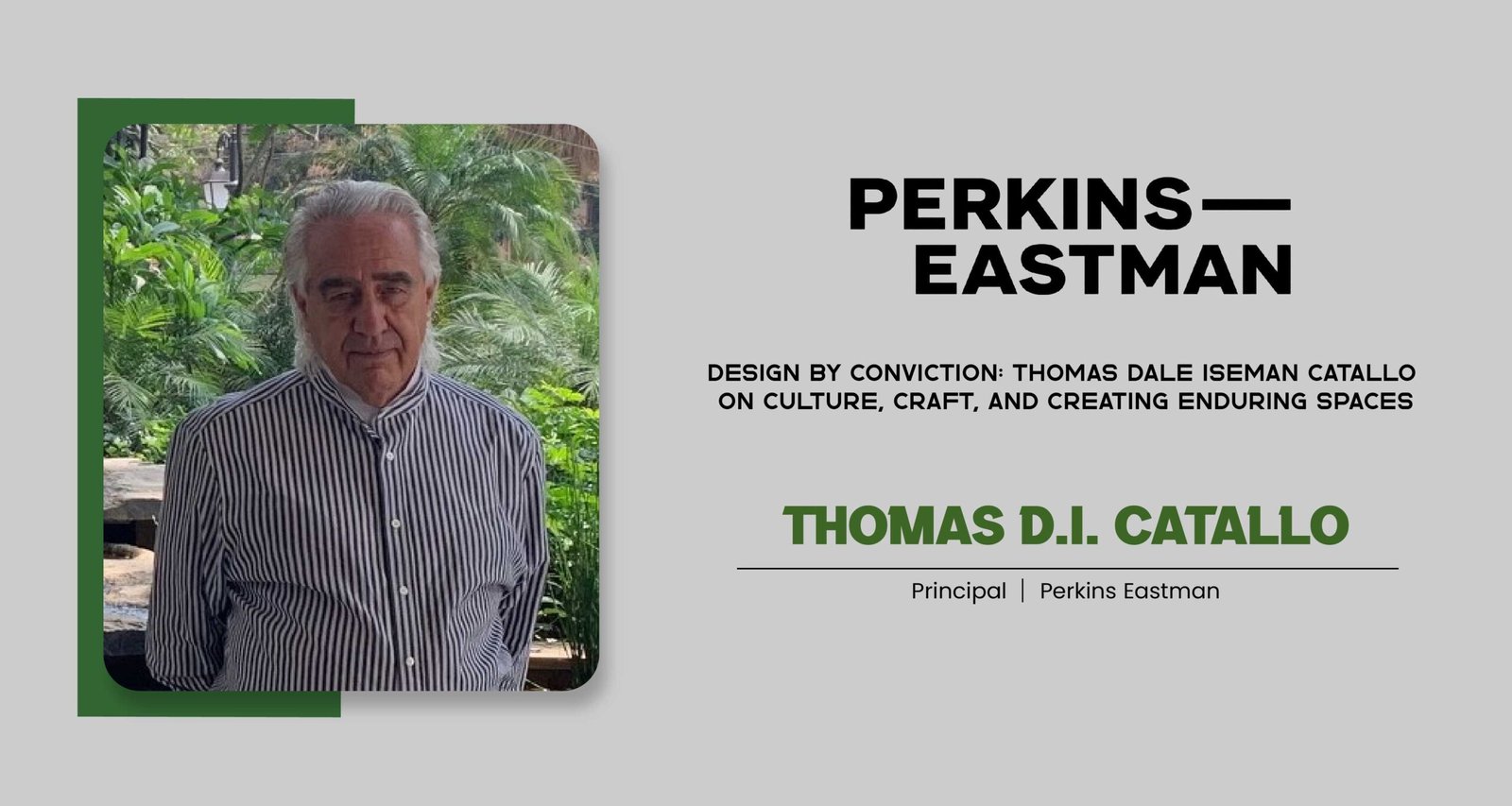
Thomas D.I. Catallo is a principal in PERKINS EASTMAN ARCHITECTS/Singapore, a world-class design & architectural practice renowned for delivering top-notch hospitality architecture and interiors across Asia, the Middle East, and beyond. He is a seasoned design professional and business leader with over three decades of experience in hospitality and commercial design, plus residential projects across the US and Asia. He is known for award-winning, culturally attuned design for hotels, resorts, and mixed-use projects.
From Sketching Futuristic Cars to Shaping Spaces
Mr. Catallo’s passion for design dates back as far as he can remember. Being recognized early by family and friends as being an exceptionally talented artistically demonstrating a natural ability to draw, a skill used throughout his professional career. That ability to visualize spaces with an artistic approach continues to sit at the core of how he develops design concepts.
Growing up in Detroit/Michigan in the US, he was also drawn to the automotive culture. Constantly sketching ‘futuristic cars,’ and eventually pursued a specialty degree in automotive and industrial design degree. The skill, however, of drawing 3-dimensional objects in space stayed with him, becoming a valuable skill in his later interior design practice.
Problem, Process, and Experience: The Foundations of Catallo’s Philosophy
Mr. Catallo’s design philosophy was shaped by a combination of science and early artistic recognition. In high school, he excelled in physics and chemistry, enjoying the ‘process of science,’ while art remained a tangential subject, except for one unique episode that stayed with him. When in grade school, about 8 years old, he submitted a Christmas card to a citywide competition. It won but went unclaimed until school officials traced it back to his third-grade school classroom. Later, his high school art teacher, Ms. Ann Myles, viewed him as a ‘prodigy’ and strongly urged him to pursue art, a suggestion that stayed with him. Upon entering university, aptitude testing confirmed a strong affinity for art with exceptional visual acuity; the latter ranking was the highest nationally in military assessments.
While in university, he was also influenced by Mr. Charles Eames, the famous talent behind Herman Miller furniture, whose approach to design was a deliberate problem-solving process which resonated strongly with his university instructors. They drilled into industrial design students that good design is not random but the result of a deliberate problem-solving process combined with intuitive talent. That principle continues to guide Mr. Catallo’s work: he focuses on human nature and how people experience a space, product, or building with shapes, color, or texture combined with (it has, and what) unexpected elements that can enhance the experience in a more natural, intuitive way.
With over 17 years of running his own practice in the US and 20-plus years working throughout Asia, he has interviewed multitudes of individuals and is shocked by how few can articulate or describe a clear ‘problem-solving process.’ When asked about how and why behind a design, he often heard only ‘I liked the way it looked,’ and noted a decline in foundational sketching and drawing skills needed to think through a problem, with an overreliance on technology and internet references. While young designers in Asia show strong software and computer proficiency with technical execution, he also observed a gap in the ability to generate original concepts from scratch without extensive digital aids, leaving many at a disadvantage.
How Culture Shapes a Global Interior Practice
Mr. Catallo’s move to Asia 25 years ago was an eye-opener. Coming from the US Midwest, he initially felt Asia was ahead of the US in hospitality design sophistication. With the rise of global media and exposure, he now sees the design capabilities of the West and Asia largely leveled. The enduring difference, however, may be the role of culture. In the US, cultural expression in interiors tends, at times, to be more homogeneous and similar, whether on the East Coast, Midwest, or West in the US, with only minor differences. Having worked in China, India, Cambodia, Malaysia, Indonesia, Sri Lanka, Myanmar, Singapore, and beyond, has experienced that each market carries distinct cultural elements that must be observed, understood, and expressed with sensitivity. The ability to listen, observe, and adapt has become crucial to his practice and to the firm’s success in Asia, and to be very aware of culture that can vary substantially from country to country within Asia.
Mr. Catallo’s Core Design Philosophy
At the core of his design philosophy is a disciplined balance between listening and leading. A leader must put ego aside, absorb the clients’ wishes, desires, and ideas while rigorously aligning with the project requirements of timing, budget, culture, and the operational needs of the project. That foundation is then layered with his team’s own creative talent, creating a layered approach that establishes a ‘sense of place’ and interpretation of local cultural elements such as patterns, colors, shapes, local environments, and artifacts.
This approach was defined early on with Mr. Catallo’s first project in India at the historic Taj Palace, Mumbai. The client’s directive was clear: avoid spaces that could belong in Kansas and focus on capturing the authentic ‘feel of India,’ which was done successfully as shown in multiple projects in the region. That pursuit of uniqueness rooted in the local environment and culture has remained central, continuing today with Mr. Catallo, whether in contemporary or traditional projects.
The purpose is to make the guest ‘comfortable and naturally connected to their surroundings’ while elevating the area and local culture within the foundation of excellent design. The core goal is to give the guest ‘a sense of place’. The effectiveness of this philosophy is reflected in the exceptionally high customer satisfaction ratings reported by both owners and operators in their projects.
The Inspiration behind the Journey
Mr. Catallo’s decision to establish his own practice stems from a long-standing drive for independence, which in turn fosters creativity. Barely 30 with a young family, he launched Catallo Associates in the US, a move that felt natural given his inclination toward leadership. In the Detroit market, he was responsible for changing the market from ‘furniture dealer-design firms’ to more professional design firms. It just felt natural.
Working in Asia, however, led to new challenges, recognizing the need for greater resources and scope. After 25+ years with his own firm – Catallo Associates in both the US and Asia- in 2022, after several discussions, Mr. Catallo transitioned to the PERKINS EASTMAN ARCHITECTS/Singapore, a leading US firm headquartered in New York City, and brought his Design team with him. The affiliation has opened substantial new opportunities across architecture, planning, and landscape architecture. The Autograph Hotel shown is a result of his work at PERKINS EASTMAN ARCHITECTS. The Autograph Hotel shown is a result of his work at Perkins/Singapore.
Pragmatic Approach to Sustainability
Mr. Catallo approaches sustainability as a practical balance instead of an absolute objective. The firm integrates the environment into sustainability but doesn’t obsess over it. It is applied, but never sacrifices design for the sake of altering materials, as it is a balance to match aesthetics with sustainability. A core part of the practice is also working with local artisans, materials, contractors, etc., which at times can limit the availability of some exclusive materials and products.
Balancing Aesthetics with Sustainability
Throughout his work, Mr. Catallo always prefers using local crafts, materials, and craftsmen and contractors to the best extent wherever possible to obtain the best appearance and feel for a space, more than ‘a look,’ and because of this, the firm often favors ‘the real materials/items’ instead of ‘similar/alternates ones’ in key spaces. It’s a judgment call as to timing, availability, cost, etc., as Luxury is not just a look, but equally important, is the feel of a space.
Conviction and Collaboration
Mr. Catallo describes his leadership philosophy as one of strong convictions balanced with collaboration. He holds precise views on planning design solutions, planning, and processes, but always listens to key team members and considers their ideas and concepts. Under extreme time or budget constraints, he tends to make and implement quick decisions. Key members are expected to justify their ideas within the context of the assignment, timing, budgets, and hotel brand. This has become more complex within PERKINS EASTMAN ARCHITECTS, where coordination with other offices and their personnel must also be factored in. With experience and a strong leadership approach, he learned long ago to follow his instincts and move forward, as time pressures are always evident.
Nurturing Creativity and Innovation
Mr. Catallo notes that nurturing creativity is complex and requires time, understanding, as each team member is unique. The primary challenges are time, schedule, and sometimes budget, which creates pressures on both individuals and the process. Despite this, he always encourages everyone to speak up. When the process becomes stalled, he often steps in to clear the jam quickly. However, when involved with other offices, there is a process of give-and-take notwithstanding client considerations.
The Long-term Vision
Operating as a part of a large Architecture firm has made the scope more complex. Markets are more competitive now, the process more demanding, and working within a multicultural environment while remaining sensitive to operator requirements adds further challenges.
In Asia, each country presents distinct issues: language, cultural, building codes, architectural style issues, contractor capability issues, language interpretation, and transportation in the countryside of some countries. The team has learned, adapted, and is doing well as our 25+ year record indicates.
As part of a large firm, he now has resources to pursue larger, more complex projects beyond interiors, such as land planning, architecture, landscape design, and large residential developments. One current project with a long-standing client includes several hundred villas, plus resort hotels and retail facilities, a scope that was not possible with his former firm. This makes the future much more interesting as well as demanding.
A Design Legacy Built on Purpose
Mr. Catallo always strives for projects to have a long-term lifespan, which has been the hallmark of his career. True to date. Almost all projects completed have achieved very high customer satisfaction ratings noted from hotel operators, notwithstanding multiple international awards. He dislikes fads, the word ‘trending,’ and focuses on ‘solving whatever problem, and also, regardless of obstacles, while delivering excellent design while ensuring the project is a financial success is paramount. For him, since university, being a designer was never ‘a job’; it was always a calling, a passion, and an instinctual drive, and he has lived by these principles for over 35 years, resulting in a plethora of international design awards over a plethora of international award-winning projects that have guided him both professionally and personally.