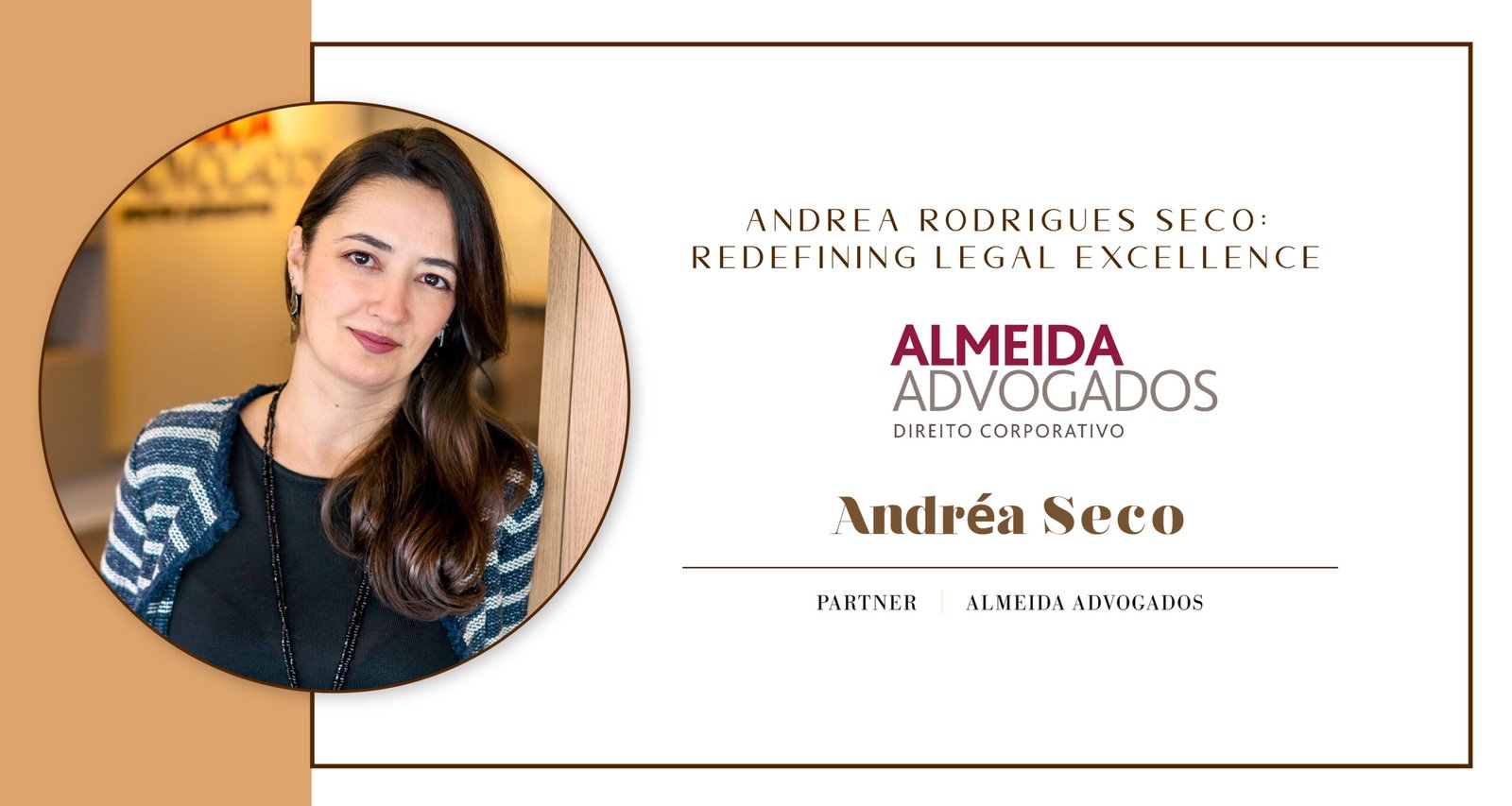
Meet Andréa Rodrigues Seco, Partner at Almeida Advogados, a full-service law firm recognized for its excellence in Corporate Law, with a focus on business consulting, dispute prevention, and strategic litigation.
From a very early age, Andréa has consistently been an avid listener. She has also maintained a keen interest in reading a wide range of subjects. She graduated in Law from the Pontifical Catholic University of São Paulo in 2000. Even as a law student, Andrea had devoted her career to corporate law, advising both domestic and international clients, with experience in areas such as corporate and civil law.
After completing her legal studies, Andréa worked for small boutique law firms and a large full-service firm. She joined Almeida Advogados in 2003 and contributed to the development of the firm’s litigation practice, ultimately becoming a partner.
Andréa pursued her LL.M. studies in Portugal, where she concentrated her academic research on one of her primary areas of interest—corporate disputes. Currently, in addition to coordinating multidisciplinary teams, Andrea continues to lead the firm’s most significant litigation matters, with active practice also in the arbitration arena.
“I was initially drawn to the legal profession by the opportunity it offers for continuous intellectual growth and meaningful impact,” she says. “Law is a field that demands constant study, critical thinking, and the ability to engage with complex and evolving issues across different sectors of society. This dynamic environment, combined with the possibility of advocating for clients and contributing to the resolution of significant disputes, made litigation a particularly compelling path.”
The Differentiating Factor of Almeida Advogados
Since its inception in 2001, Almeida Advogados has distinguished itself in Brazil’s highly competitive legal market through a combination of technical excellence, strategic vision, and a genuinely client-centered approach. According to Andréa, the firm’s strength lies in its ability to understand not only the legal dimensions of a matter but also the broader business realities its clients face.
“Our work is grounded in a deep understanding of our clients’ businesses, industries, and cross-border challenges, which allows us to deliver legal solutions that are not only precise, but also effective,” she says. “We prioritize close partner involvement in complex matters, ensuring agility in decision-making and consistency in the quality of advice.”
This commitment to hands-on leadership, combined with extensive experience representing both Brazilian and international clients, enables Almeida Advogados to bridge different legal cultures and expectations with clarity and efficiency.
The Evolving Legal System of Latin America
Andréa firmly believes Latin America’s legal industry is being reshaped by a convergence of structural, technological, and regulatory transformations that are redefining the role of legal counsel. In Brazil in particular, she sees a phase of regulatory maturity, further marked by structural reforms, increased compliance requirements, and a growing expectation that legal departments serve as strategic partners to business.
At the same time, this shift is accompanied by the rapid integration of technology, especially artificial intelligence, data protection frameworks, and digital regulation, which is not only creating new areas of advisory work but also reshaping dispute resolution and risk management. At the same time, the continued expansion of sectors such as fintech, digital markets, and infrastructure is driving increasingly complex, cross-border legal matters, requiring lawyers to operate with a more global and multidisciplinary perspective.
From a litigation standpoint, Andréa identifies a particularly relevant trend: the growing sophistication of dispute resolution mechanisms, including a notable rise in arbitration, reflecting clients’ demand for efficiency and specialization.
Digital Transformation is Key
Over the past few years, Andréa is witnessing how digital transformation is reshaping litigation and dispute resolution, particularly in terms of efficiency, scale, and data management.
The rise of artificial intelligence tools, advanced analytics, and digital platforms has streamlined document review, enhanced legal research, and enabled more sophisticated case strategy through predictive insights for the better. In Brazil, courts and arbitral institutions have also accelerated the adoption of electronic proceedings, virtual hearings, and digital evidence management. This has reduced several procedural bottlenecks and expanded access to justice. According to Andréa, technology is not merely improving existing processes; it is fundamentally changing how disputes are prepared, presented, and resolved in an increasingly complex legal landscape.
Yet, despite these advances, she doesn’t forget to emphasise that technology is still a tool rather than a substitute for legal expertise. “Without a doubt, technology is a powerful enabler, but it does not replace the core attributes of a skilled litigator: critical judgment, strategic thinking, ethical discernment, and the ability to advocate persuasively in high-stakes scenarios,” she explains.
Mentoring the Next Generation of Lawyers
Andréa firmly believes that mentoring is more about shaping judgment, resilience, and professional identity.
“Over the course of my career in complex litigation, I have come to view the development of younger lawyers as a deliberate and continuous investment—one that requires both structure and genuine engagement,” she says. “I prioritize exposing associates early to substantive work, encouraging them to move beyond purely operational tasks and to understand the strategic dimensions of a case.” This includes involving associates in client interactions, hearings, and the construction of legal arguments, so they can appreciate not only the “what,” but the “why” behind each decision.
She feels it’s equally important to foster critical thinking and intellectual independence. Rather than providing immediate answers, it is far more important to challenge younger lawyers to defend their positions, anticipate opposing arguments, and refine their reasoning.
“In the Latin American and Brazilian legal markets—where legal systems are dynamic and increasingly interconnected—this analytical rigor is essential. Technical excellence remains fundamental, but what distinguishes an outstanding lawyer is the ability to navigate uncertainty, communicate persuasively, and adapt to evolving legal and business environments,” she explains.
Andréa also emphasises that ethics, professionalism, and long-term career vision are equally important. Litigation can be demanding and, at times, adversarial, but integrity and respect must remain non-negotiable. She encourages young professionals to build their reputations not only on results, but on credibility and consistency. At the same time, she understands that it is important to support them in identifying their individual strengths and career aspirations, recognizing that the next generation values purpose and balance alongside professional achievement.
Latin American Legal Professionals on the Global Stage
According to Andréa, Latin American legal professionals are extremely well positioned to assume a more prominent role driven by the region’s growing involvement in complex cross-border transactions, international arbitration, and regulatory developments.
Brazil, in particular, has further strengthened its position as a vital jurisdiction in infrastructure, energy, and financial services sectors. As investment increases and projects become more sophisticated, the legal work generated within these industries requires constant interaction with international investors, regulators, and business stakeholders. This environment has elevated the role of legal counsel beyond traditional advisory functions, creating opportunities for lawyers to serve as strategic partners in navigating complex, multi-jurisdictional matters.
A Long Lasting Legacy
Throughout her career, Andréa’s foremost aspiration has been to contribute to a legal practice grounded in excellence, integrity, and a genuine commitment to justice.
“The legacy I hope to leave is not limited to the cases I have handled, but rather reflected in the standards I have helped uphold—rigorous legal reasoning, ethical decision-making, and a client-centered approach that balances technical precision with strategic vision,” she explains. “In an increasingly complex and demanding legal market, I believe that consistency in these principles is what ultimately strengthens both the profession and the institutions it serves. Equally important is the impact on people. If I have helped shape professionals who are not only technically skilled, but also guided by integrity and a sense of purpose, then I consider that a lasting and meaningful legacy within the legal profession.”