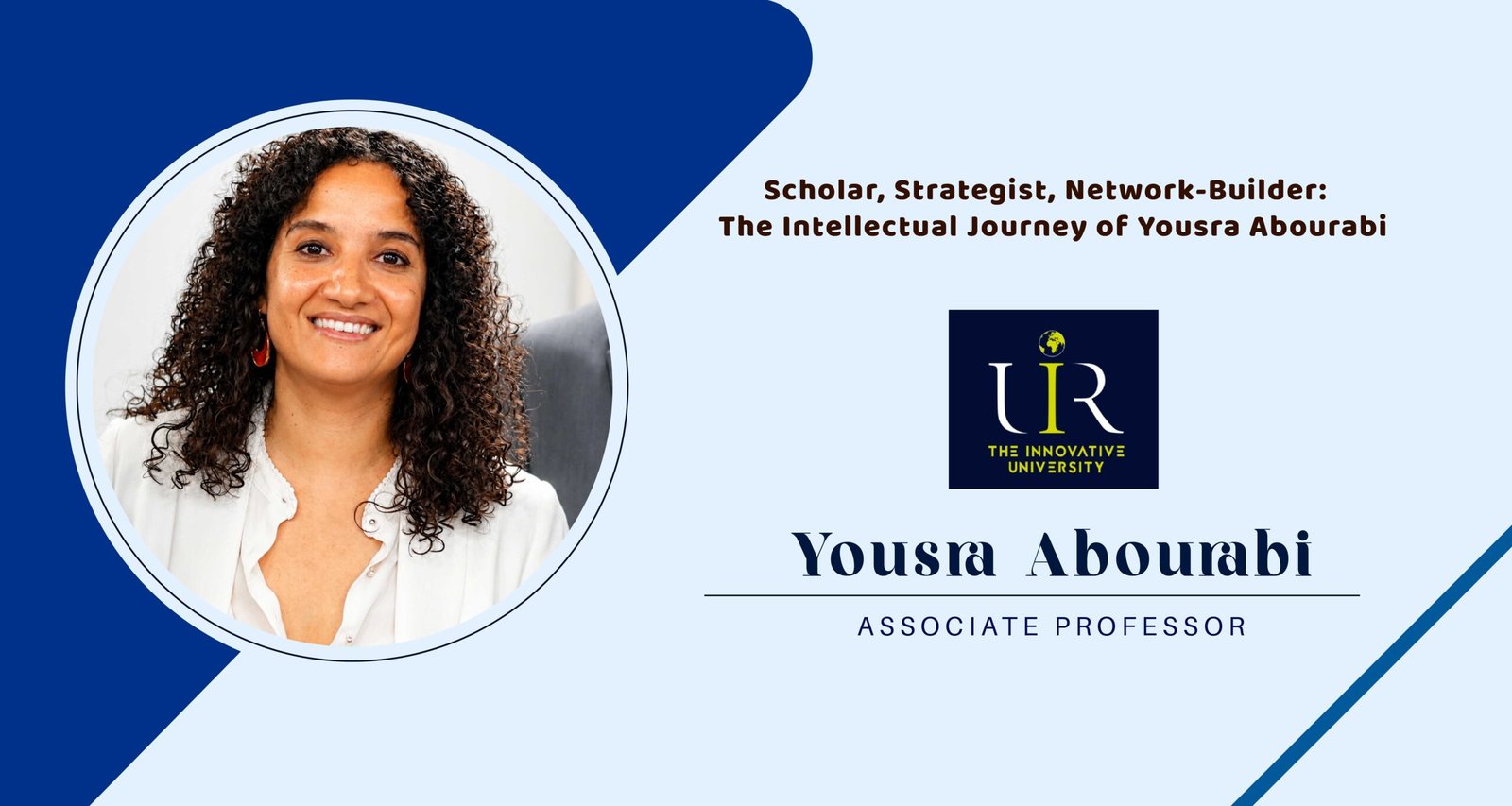
Yousra Abourabi is a strategic political scientist and international relations scholar advancing African international governance, climate politics, and gender research across academia and policy in Africa. In her tenure as faculty at the International University of Rabat, she helped build the country’s fully fledged schools of political science within a public-private institution. She holds a PhD in Political Science and International Relations from the Université Jean Moulin Lyon 3 (in France) and two fellowships at the Käte Hamburger Kolleg Centers for Advanced Study in the Humanities (in Germany) and the Leiden University Center for African Studies (in the Netherlands). She is also a member of the Economic, Social, and Cultural Council (ECOSOCC) of the African Union as well as the Global Campus for Human Rights. Her work extends beyond teaching and academia to include policy expertise with public and private institutions, scientific program development, and capacity-building initiatives.
Building Political Science Education and Networks
Born and raised in Rabat, Morocco, Yousra Abourabi completed her higher education in Europe and Latin America, engaging with diverse intellectual traditions on power, development, and global order. After earning a PhD on Morocco’s Africa policy and South-South cooperation in 2017, she returned to Morocco to support the training of the next generation of decision-makers. She joined the International University of Rabat, the first public-private university in the country with a fully fledged school of political science; its development became both an intellectual and a personal commitment. Since then, she has advanced political science education in Africa through the development of the discipline in Morocco and active participation in an influential and recognized intra-continental academic network.
The Key Inspiration: Shaping a Scholarly Path
Yousra Abourabi’s interest in political science and international relations began early, driven by a curiosity about power and domination. Identifying as a feminist, she centered this lens in her intellectual trajectory.
In 2005, she researched Tuareg matriarchal systems, and in 2007, at the age of 19, she did her first field research for two months across the Sahel, in Burkina Faso and Mali. The journey grounded her academic focus in lived experience and a commitment to questioning dominant frameworks. She continued to travel extensively throughout Africa as part of her career.
She sees parallels between patriarchy and neocolonialism as systems shaping norms and access to power and explores how global and local forms of inequality intersect and persist. Political science and international relations offered her the tools to analyze these dynamics and, importantly, to challenge them.
At the same time, she was drawn to several professional paths, including humanitarian work, journalism, and diplomacy. She chose academia because it offered a unique balance between intellectual freedom and potential for meaningful societal impact.
Connecting Research to Policy
For Yousra Abourabi, research relevance begins with extensive fieldwork alongside practitioners, institutions, and civil society to grasp how policies are constructed and implemented.
She conducts field studies in Morocco, particularly in the Beni Mellal-Khénifra and Tangier-Tetouan-Al Hoceima regions, as well as in partner countries such as Senegal, Côte d’Ivoire, South Africa, Ghana, and Ethiopia, focusing on communities of practice in environmental governance.
She examines how agroecology practitioners generate knowledge, engage public policy, and navigate institutional frameworks, using interviews and network mapping to trace how local ideas circulate and influence national and global norms. This pathway of agency reveals how local practices shape development priorities and everyday decisions. She draws on all her expertise to support African CSOs in their environmental advocacy work, as well as to train CSOs and African diplomats in climate negotiations.
Policy Practice Informing Pedagogy and Research
Yousra Abourabi’s engagements are not peripheral to her academic work; they are central to it, providing insight into policy design and implementation while enabling translation of scholarship into actionable recommendations.
She has served as an expert on several projects for international organizations (the World Bank, UN Women, UNECA, IOM, UNDP, the AU, etc.) and has worked with a number of other international development institutions such as AFD and the GIZ. For example, she has contributed to consultative processes aimed at strengthening the integration of gender-sensitive monitoring tools into Senegal’s Nationally Determined Contributions (NDC 3.0), to efforts assessing and building on Morocco’s gender-responsive budgeting framework for environmental public policies, and to a major study on the resilience of Morocco’s health system to climate change, among other assignments.
In teaching, she uses policy case studies to move students beyond theory and leverages her network to help graduates access professional opportunities.
Three Transformations Shaping African Higher Education
Yousra Abourabi identifies three key transformations in African higher education.
First, academic fields are diversifying, with universities like UIR expanding into political science, renewable energy, aeronautics, and public health to meet emerging challenges.
Second, more women are graduating, even in historically male-dominated fields, but gender stereotypes and barriers to leadership and equal pay persist.
Finally, intra-continental cooperation is growing through student and faculty mobility, joint programs, and research collaborations, with growing funding opportunities.
Aligning Academia with Africa’s Challenges
For Yousra Abourabi, universities should re-center faculty within a system that connects them to applied and action-oriented research, especially in social sciences, which are critical for informing public decision-making. These types of initiatives should not remain individual efforts, as social sciences are still less valued and underfunded compared to “hard sciences” and business programs.
To align with Africa’s challenge, universities should engage ministries and international donors as centers of expertise and challenge large consulting firms despite their underestimated local capacity. Curricula should also evolve to equip students for work with public institutions while preserving tradition for fundamental non-applied research.
Interdisciplinary Literacy for Policy Leadership
Yousra Abourabi notes that socio-political and environmental challenges like climate change demand cross-disciplinary engagement. As a political scientist, she must understand climatology, biology, economics, and sociology to address such issues meaningfully. This requires disciplines to make knowledge accessible and invest in translation and dialogue between fields.
In her department, she fosters intellectual curiosity and openness, arguing that future leaders in public institutions must interact with diverse experts to design and implement effective policies.
Inspiring Critical Global Thinkers
Yousra Abourabi sees her biggest influence as shaping how future leaders think, question, and act, and not only in measuring impact through numbers and jobs created. Her course on international relations and African governance focuses on normative power and agency, encouraging students to examine who defines norms and how African actors can shape, negotiate, or challenge them.
Yousra Abourabi’s teaching starts from the idea that political analysis also begins with the position from which one speaks. Drawing on Kimberlé Crenshaw, Michel Foucault, and Edward Said, among many others, she invites students to question categories that often appear self-evident: identity, neutrality, universality, and otherness. Her courses show how identities are constructed through social and political relations, how “regimes of truth” are historically produced, and how representations of the Other shape power relations. She gives particular importance to recent scholarship produced from Africa, while putting it in conversation with authors from Latin America, Asia, Europe, and the United States. The aim is not to add diverse perspectives to an existing canon but to examine how knowledge is produced, who is authorized to speak, and how dominant narratives can be unsettled.
Agency, Rootedness, and Responsibility
Yousra Abourabi believes the next generation must develop a strong sense of agency to shape systems, not just adapt to them. This requires critical thinking, intellectual independence, and the confidence to challenge dominant narratives shaped by North-South relations, the international economic systems, or gender relations.
At the same time, her works remain deeply rooted in local contexts while engaging with global debates. Finally, she believes that a strong sense of responsibility is key. Scholars and leaders must be committed not only to knowledge production but also to its impact on society.
The Future Outlook: Africa’s Higher Education
Yousra Abourabi envisions a future where higher education in Africa remains affordable for all, warning that privatization of education and healthcare risks deepening inequalities and saddling graduates with long-term debt that limits personal and professional fulfillment.
She emphasizes expanding intra-African mobility and cooperation, as studying and working across African contexts empowers local grounding and nurtures opportunities for research and collaboration.
Positioning African Thought Within the Global Knowledge Economy
Yousra Abourabi is particularly attentive to the intellectual transformations accompanying Africa’s repositioning in global knowledge production. She emphasizes that universities abroad increasingly seek partnerships with African institutions not merely as sites of data collection but as spaces of theoretical and epistemic production grounded in situated knowledge. In this regard, she is involved in the IPORA network (Interdisciplinary Policy-Oriented Research on Africa), a research platform that brings together several African and European universities through a deliberately equitable governance structure aimed at fostering co-production of knowledge and rebalancing academic hierarchies. She also contributes to the Africa–Asia “New Axis of Knowledge” initiative, developed with Leiden University and partners across three continents, which promotes horizontal and dialogical exchanges between academic communities. In addition, she is engaged in the ARMA program of the Global Campus of Human Rights, which supports advanced training and research on human rights in the Arab region.
Through these collaborations, she sees a real opportunity to consolidate African schools of thought and position them within the global knowledge economy.