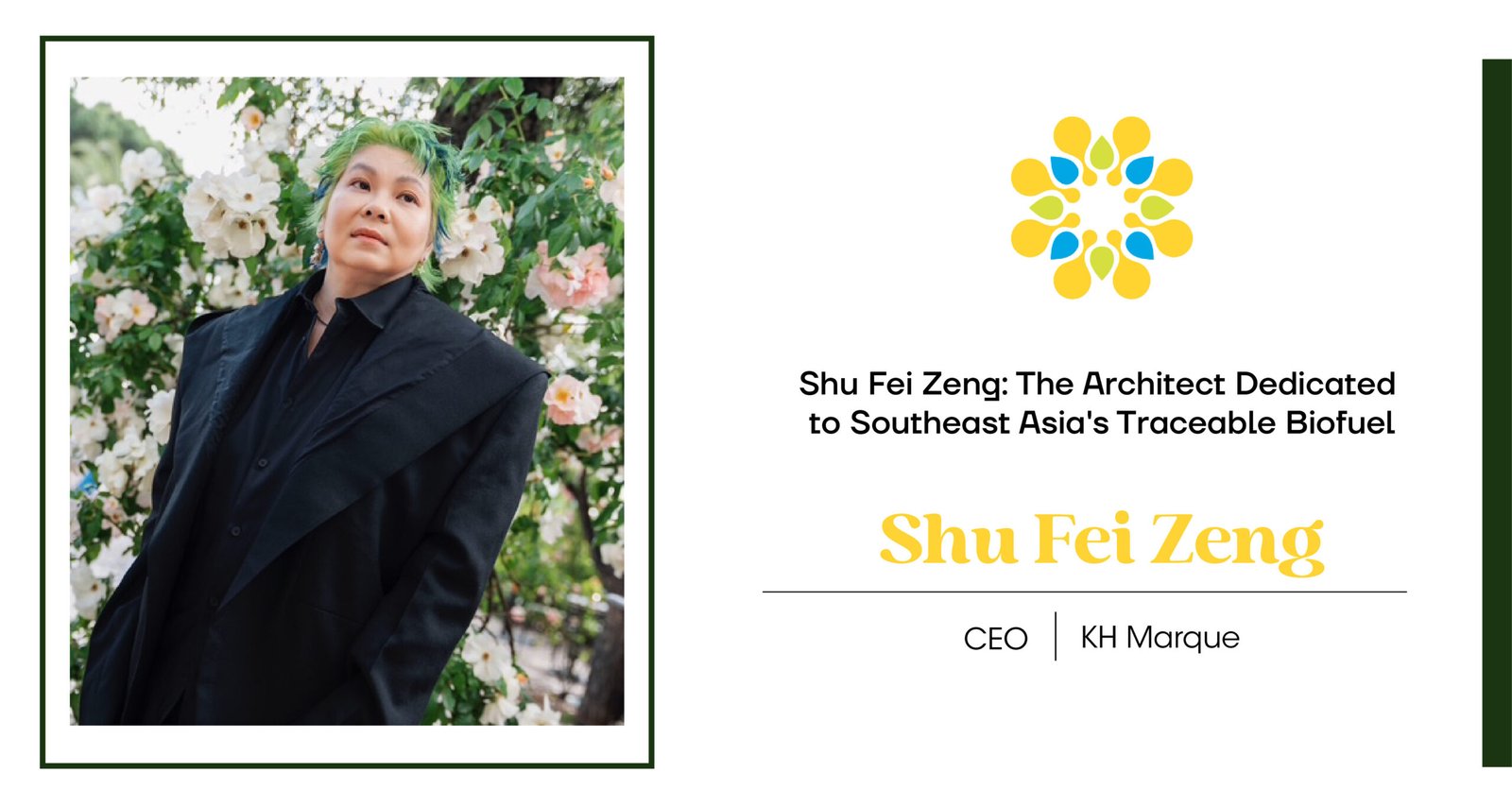
Shu Fei Zeng, Founder and CEO of KH Marque, is a sustainability entrepreneur and energy market leader dedicated to transforming waste into certified low-carbon fuel at scale. With over two decades of expertise in senior leadership at Vitol and Glencore, she has built a mission-driven enterprise that blends supply chain precision with environmental impact.
Through KH Marque, she converted Southeast Asia’s used cooking oil sector into a transparent, compliant supply chain now spanning 11 nations. The result is a new global benchmark for traceable, low-carbon feedstock serving the world’s largest aviation and energy companies.
Shu Fei’s Journey: From Commodity Trader to Climate Architect
Shu Fei’s remarkable career began in global commodity trading before shifting towards sustainable energy, driven by a long-standing commitment to environmental impact. When Net Zero 2050 targets emerged, she saw only one scalable solution: using waste as feedstock. She chose to focus on used cooking oil (UCO) because it aligned with the global demographic. A growing population means more food establishments and, in turn, more UCO generated.
UCO has zero greenhouse gas emissions at the feedstock level. When converted to Sustainable Aviation Fuel (SAF) or Renewable Diesel (RD), the end product has 88% to 93% of greenhouse gas savings compared to fossil fuels.
Shu Fei identified a critical market gap. Before she ventured into the UCO collection business, supply largely came from informal, unverifiable networks prone to fraud and regulatory noncompliance. As standards tightened, the industry needed full documentation, with every drop of oil, verifiable and auditable. She moved to fill that gap by formalizing UCO collection across thousands of vendors in Southeast Asia. Shu Fei educated the vendors on the commercial and environmental value of the UCOs they previously discarded.
To enable compliance at scale, she created a proprietary platform called the Green Tracker. The application tracks and documents every single drop of UCO collected, capturing GPS coordinates for each vendor and the distance the oil travels. The data allows buyers to calculate the Carbon Intensity Value (CI) of their end product with precision and confidence.
The Defining Moment: Recognising Potential of Waste-to-energy Solutions
The defining moment came early in Shu Fei’s career. She joined the renewable energy desk at Masefield AG in 2006 and then moved to Glencore in 2009. At the time, biofuels were produced from edible oils such as palm oil, soybean oil, and rapeseed oil. That raised a lot of debate over food versus fuel. As sustainability certifications emerged and the European Union began requiring greenhouse gas savings of at least 75%, she realized edible oils would not meet the criteria. Waste feedstock was the only viable option.
That insight prompted her to launch her own company to collect UCO. With zero lifecycle emissions at the feedstock level, UCO could deliver end products with greenhouse gas savings of at least 88%.
Shu Fei had a head start. Long before Net Zero 2050 targets were announced, she was already collecting UCO and supplying major European aggregators. When global decarbonization commitments accelerated, oil majors began retrofitting refiners to produce renewable energy. The demand for waste feedstock increased, and UCO became one of the world’s most sought-after commodities.
From that point onward, waste (UCO) to energy was no longer just a concept. It became a practical solution that could address both environmental issues and supply chain inefficiencies. This insight laid the foundation for building a system that connects waste generation directly to renewable energy production.
The idea that “waste is not just waste” became the central principle guiding her work, connecting waste generation directly to renewable energy production.
How Global Experience Shaped a Circular Enterprise
Shu Fei’s experience at a global trading firm shaped a rigorous, end-to-end approach to building a sustainability-focused enterprise. She gained deep experience in supply chain operations, negotiation, and risk management, with full visibility from the origin to the end user. It helped her a lot in structuring the operations from collecting from small food vendors and cleaning the UCO to bulk onshore tanks.
Recognizing that the UCO industry was fragmented, Shu Fei built a stable ecosystem that connects collection, processing, and delivery. Drawing on standards from the major trading houses, she instilled strong accountability and professionalism. Buyers receive contractual certainty, and KM Marque has never defaulted on a contract, regardless of market volatility.
Scalability was embedded from the outset. Without exposure to international markets, she understood that sustainability solutions must extend beyond local boundaries. KH Marque was designed to support regional and global demand from day one.
Waste to Jet Fuel: KH Marque’s Mission
KH Marque is a sustainability-driven enterprise focused on transforming waste into certified low-carbon resources. The company collects UCO at scale and supplies it as feedstock for sustainable aviation fuel and renewable fuels, with lifecycle greenhouse gas emissions up to 88% lower than fossil fuels.
Operating across Singapore and Malaysia, Shu Fei has built an integrated ecosystem that includes waste collection, proprietary purification processes, and digital traceability systems. This ensures UCO is recovered efficiently while meeting the strict requirements of global biofuel producers.
She developed a proprietary platform, the Green Tracker, which turns UCO collection into a fully traceable and compliance-ready supply asset. It has become an essential tool for global energy refiners managing regulators across multiple continents. No comparable system had existed at this scale before KH Marque.
KH Marque plays a critical role in bridging local waste generation with global energy demand. By connecting restaurants, hotels, businesses, and international buyers, the company enables everyday waste to become part of the renewable energy supply chain.
Turning Waste into Low-Carbon Energy at Scale
KH Marque’s model is built on circular economy principles, turning waste into resources instead of letting it end up in landfills or waterways. The company collects used cooking oil, purifies it, and supplies it as feedstock for renewable fuels. This reduces reliance on fossil resources and prevents improper disposal. The process also creates a new revenue stream for food vendors who previously discarded their UCO.
The integration of digital tools strengthens the model. KH Marque’s proprietary Green Tracker app enables oil majors and other partners to track waste collection, calculate carbon intensity (CI), and monitor emissions reductions. This ensures transparency and delivers a measurable environmental outcome.
Overall, she has designed a closed-loop system that cuts emissions, improves resource efficiency, and supports sustainable supply chains.
The Strategy Behind KH Marque’s Regional Expansion
KH Marque’s rapid expansion across Southeast Asia has been driven by a combination of operational discipline, technology integration, and strategic partnerships.
One key strategy was formalizing a fragmented sector. By introducing structured collection systems and transparent pricing, the company created reliability and trust within the supply chain. Technology was also critical. The application Green Tracker improved operational efficiency, enabled end-to-end traceability, and enhanced engagement with stakeholders.
In addition, KH Marque built strong partnerships across the value chain. Local suppliers ensured a consistent feedstock supply, while international biofuel producers provided stable demand. This approach, combining grassroots participation with global market integration, enabled fast, sustainable expansion across the region.
Major Challenges in Formalising the Informal
Shu Fei faced one of the main challenges of transitioning suppliers from informal, unstructured practices to a more formalized system. Many were used to cash-based transactions with little transparency.
Education was also key to helping stakeholders understand the long-term benefits of structured waste management. As suppliers experienced improved efficiency and operational stability, confidence in the system grew. This gradual shift enabled KH Marque to formalize the sector while maintaining strong and lasting relationships with its supplier network.
How Awareness Drives Consistent Participation
Shu Fei views education and awareness as critical to securing long-term participation in sustainable initiatives. Without understanding the impact of their actions, she notes, individuals and businesses are unlikely to engage consistently in sustainability efforts.
KH Marque embeds awareness into its operations by making outcomes visible. Through the Green Tracker app, participants can track carbon savings and see how their contributions directly support renewable energy production.
This transparency helps shift mindsets. Sustainability becomes tangible when individuals can see measurable results. As awareness grows, participation becomes more consistent, reinforcing a culture of responsible waste management. Food vendors also gain new revenue streams, creating a practical incentive alongside environmental benefits.
KH Marque’s Vision for a Low-Carbon Supply Chain
Shu Fei’s long-term vision is to build a globally integrated, traceable supply chain for low-carbon feedstock. This involves expanding collection networks into new regions and deepening partnerships with international biofuel producers. A core focus is strengthening traceability and compliance systems to meet evolving global standards. By ensuring transparency at every stage, KH Marque aims to set benchmarks for the industry. The ultimate goal is to connect local waste streams to global energy markets at scale, driving emissions reduction in hard-to-abate sectors like aviation and transport.
Beyond operational growth, Shu Fei prioritizes integrating physical waste collection with digital infrastructure. KH Marque is enhancing its data capabilities to track feedstock flows, carbon intensity (CI), and lifecycle emissions with greater granularity. This supports customers in meeting ESG and regulatory requirements while digitizing the entire value chain—from collection to conversion.
She also emphasizes expanding stakeholder participation. Future initiatives include deeper engagement with municipalities, commercial partners, and community networks to scale collection volumes while maintaining traceability and quality. By aligning infrastructure, technology, and behavioral change, she believes.
KH Marque can proves that circular economy systems can be both commercially viable and environmentally transformative at scale.
Powering the Global Shifts to Net Zero
Shu Fei believes Asia plays a major role in the global energy transition because of its scale and faster economic growth. The region creates large volumes of waste that can be converted into renewable energy, creating significant opportunities for circular economy solutions. Her work in the UCO collection, she notes, is only a contribution to a much larger ecosystem. She sees potential to bring more food vendors into the system by focusing on education and raising awareness of how used cooking oil can help protect the planet.
At the same time, growing policy support and investment across the region are accelerating the adoption of sustainable technologies. She points to Asia’s ability to combine innovation with scalability as a key driver of global decarbonization efforts. Through regional collaboration and efficient systems, Asia can contribute meaningfully to achieving global climate targets.
Emerging Opportunities: From Forest Roots to Net-Zero Goals
Growing up in a small neighborhood in Malaysia, Shu Fei spent her childhood beside a forest. Her mother would take her to swim in the river and catch prawns or fish. She recalls the big trees looming over her, and it was the most beautiful sight. Today, there is a huge difference. In 2024, Mount Fuji went without a snowcap for the longest time in 130 years. Glaciers are melting, and images of stranded polar bears have become symbols of a warming planet. This shifts her commitment to the Net Zero 2050 targets. She wants to look back knowing she did something for the planet and that future generations will not be disappointed by inaction today.
She is particularly excited by the growing recognition of UCO as a valuable resource. As industries transition toward net-zero targets, demand for sustainable feedstock is accelerating. This shift is creating opportunities for innovation in both technology and system design, with digital traceability, circular supply chains, and cross-border collaboration becoming important.
Another key opportunity lies in connecting local actions to global impact. By enabling communities and businesses to participate in sustainability efforts, it is possible to create scalable solutions that deliver measurable environmental outcomes.
The transition to net zero is not only about reducing emissions but also about rethinking how resources are used. This shift opens new pathways for sustainable growth and long-term environmental impact.